



Hey folks! Pure Awesomeness here…your friendly neighbourhood Lifecycle Larrikin…also known as “the guy who hit ‘Retain Forever’ at 4:59pm on a Friday and has been emotionally processing it ever since.
Because therapy is pricey and regulatory fines are even pricier (looking at you, compliance), I’m back again talking all things Purview…specifically Data Lifecycle Management. Or in other words…that quiet overachiever in the corner that stops your SharePoint from turning into a digital episode of Hoarders: Enterprise Edition.
It’s the unsung hero that keeps your content compliant, your storage under control and your future self from asking, “Why do we still have invoices from 2007?”
This all sits within broader Microsoft Purview compliance and governance capabilities that help organisations reduce risk and manage data effectively.
Grab your cup of liquid gold and buckle up!
Here we go!
The Circle of (Data) Life: From Birth to Deletion Without Tears
Data. It’s born. It grows. It gets misfiled. It gets forgotten and eventually, someone asks, “Why is this 2011 pricing spreadsheet still in SharePoint?” That, my friends, is why Data Lifecycle Management (DLM because we just can’t get enough of these acronyms) exists. It’s to save us all from drowning in ancient OneDrive relics and Teams chat archaeology. In Purview, DLM is the majestic conveyor belt of governance: retain the important, archive the required, delete the useless and automate everything so humans don’t mess it up.
Microsoft Purview manages this lifecycle with rules, retention labels, policies and automation that transforms chaos into controlled compliance. You no longer need to hunt for old rubbish like a digital bin chicken. Why I hear you ask? Purview does it for you! It makes sure data sticks around when laws demand it and disappears when it becomes a risk, all while creating audit trails cleaner than a freshly windexed boardroom table.
Retention Labels: The Stickers That Actually Save Your Career
You know how kids put stickers on everything? Retention labels are the grownup, enterprise version, but instead of “PAW PATROL LET’S ROLL,” you’ve got labels like “Finance – Retain 7 Years,” “Legal Hold,” and everyone’s favourite: “Delete After 30 Days (No, Seriously).” When applied, these labels dictate exactly how long a piece of data must remain available, whether it can be modified and when it should be permanently deleted. I mean let’s face it, the last thing you want is to get a knock on your door from the auditor and you having to explain why you have a file called “ThisMayContainCreditCardInfo.docx” that contains credit card numbers from the days of dial up internet. For all the Gen-Z readers…that’s what we used back in the day to download a 3MB file that would take approximately 39 years, 8 days, 56 seconds to complete the download.
The beauty? Labels can be slapped on automatically. No more begging users to file documents properly.
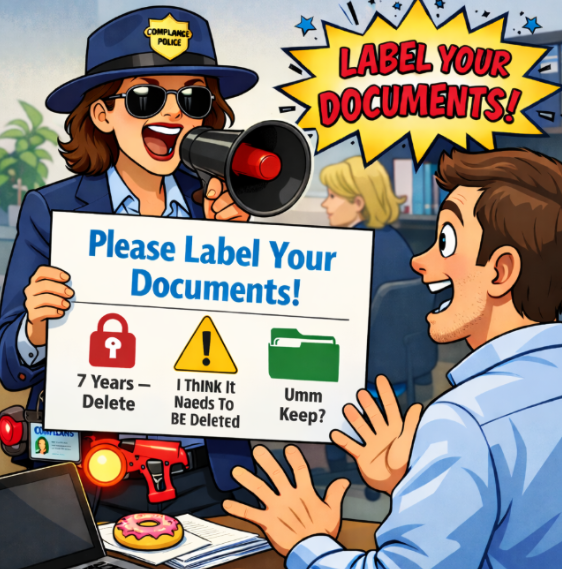
Purview scans content, identifies sensitive data and applies the right label with machine intelligence that outperforms most corporate filing habits. Combine that with disposition review workflows and you’ll have a deletion process more accountable than your last performance review.
Retention Policies: Because Sometimes You Need a Giant Governance Blanket
Labels are great, but sometimes you want to put governance over everything, like wrapping your tenant in a giant regulatory doona. Enter Retention Policies, the catchall mechanism for Teams chats, SharePoint sites, OneDrive accounts, Exchange mailboxes and more. These policies apply rules across entire workloads, giving you organisationwide consistency without needing every file labelled like a Year 4 lunchbox.
Want to retain all Teams messages for 7 years? Easy. Want to delete everything in a particular SharePoint site after 3 years? Done. Want to make sure OneDrive accounts for departed staff don’t become ghost towns filled with abandoned memes? Purview’s got your back. Policies mean you can enforce compliance at scale without manually chasing individuals who haven’t cleaned their digital room.
AutoClassification: When AI Becomes the Office CleanUp Crew
Before Purview, data classification involved a lot of guesswork, tribal knowledge and the occasional Excel file named “FINAL_FINAL_NO_REALLY_THIS_ONE.xlsx.” But with Microsoft’s autoclassification engine, content is analysed using machine learning models (yes, everything is machine learning these days!), pattern recognition and sensitivity intelligence. The system quickly identifies personal data, financial data, health information, contracts and even highrisk keywords.
This is where Data Lifecycle Management truly becomes magical. Based on classification, Purview automatically applies retention labels, triggers policies and sends data down the right lifecycle path without human error stepping in to ruin the party. Imagine an army of AI librarians silently tidying your digital universe, except they never take holidays, never send passive aggressive emails and always file things correctly.
Disposal, Review and The Art of Letting Go
Ah yes, the end of the data life journey. The great digital beyond. The final push into nonexistence. Purview’s disposition review process ensures that deletion is compliant, documented and (most importantly) defensible when auditors inevitably ask, “Why did you delete this invoice from 2018?” Instead of shrugging and blaming Steve from Accounting, you can provide a clear audit trail showing that the data was deleted according to the retention policy.
But the true beauty? You get dashboards and insights into what’s pending deletion, what’s already gone and what needs reviewing. With automation, most data can be deleted without human intervention at all. No guilt, no hesitation…just clean, lawful good governance.
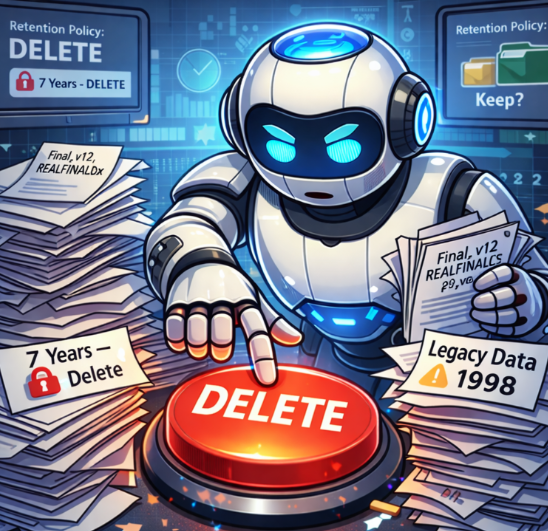
Purview lets you Marie Kondo your entire tenant: if a file does not spark compliance joy, it gets a scheduled, orderly farewell.
Ready to bring order to your data chaos and strengthen compliance? Contact Insentra to design and implement a Microsoft Purview strategy tailored to your organisation.
Until next time…
Pure Awesomeness signing off!
“The best way to predict the future is to create it.” — Abraham Lincoln