



Why information discipline not AI investment will determine who wins in 2026 and beyond.
The Question Boards Aren’t Asking
Across Australia, AI is no longer experimental. It is budgeted, piloted and increasingly embedded in day-to-day operations.
Boards are asking how quickly it can scale and where value will emerge. Investment committees are approving AI programmes. Technology teams are deploying tools. The momentum is real and it is accelerating.
But fewer executive teams are asking the question that will ultimately determine whether AI becomes an accelerant or a liability:
What will AI reveal about the state of our data?
AI does not create new vulnerabilities. It amplifies existing access permissions. If a finance analyst can access sensitive payroll files, AI can summarise them in seconds. If customer data is duplicated across uncontrolled environments, AI will draw from all of it. If ownership is unclear, accountability dissolves at machine speed.
The technology is not the risk event. It is the spotlight. And right now, across a significant number of Australian organisations, there is a great deal being illuminated that nobody has been looking at.
The Numbers That Should Concern Every Board
1,113
Notifiable data breaches recorded in Australia in 2024. This is a 25% increase on the prior year (OAIC).1
Majority
Of those breaches were not caused by sophisticated external actors. They were caused by human error, oversharing, and weak internal governance.
The pattern is clear. The risk is not primarily external. It is structural. When AI enters that structure, it does not solve it, it scales it.
The Governance Illusion
Why Compliance Maturity Is Not Information Maturity
For years, organisations have equated maturity with control frameworks, Essential Eight uplift programmes, and compliance reporting. These matter. But they have created a dangerous and increasingly costly illusion.
Technical control is not the same as information discipline. Boards must understand the difference before their AI tools make it visible for them.
In practice, across mid-market and enterprise environments, a consistent pattern emerges:
- SharePoint and Teams environments that are chronically overshared
- Sensitive HR and finance data accessible far beyond operational need
- External guest access never reviewed, sometimes years after the relationship ended
- No clear ownership of workspaces, or accountability when incidents occur
- AI pilots initiated without visibility of what staff can actually access
Controls may exist on paper. In practice, information entropy is accelerating daily and AI will make that entropy impossible to ignore.
The Three Risks Boards Are Underweighting
1. Regulatory Exposure. Australia’s privacy reform trajectory is increasing expectations around data minimisation, retention discipline, and breach accountability. When sensitive data is sprawl-driven rather than lifecycle-managed, exposure compounds silently and surfaces publicly.
2. Security Amplification. AI does not introduce new access pathways. It operationalises existing ones. If your governance is weak, AI will find every gap and surface it at scale.
3. Strategic Drag. When information is duplicated, stale, or untrusted, executives slow down. Reporting cycles extend. M&A due diligence becomes painful. Operational clarity suffers. This is not simply a cyber risk. It is a competitive disadvantage measured in decision velocity.
The Question Has Changed
From Protection to Trust
Boards have traditionally framed data risk around intrusion. Can someone get in? The defensive posture firewalls, MFA, patching, backup was built to answer that question.
The emerging AI era shifts the frame entirely.
The question is no longer ‘Can someone get in?’ It is ‘Can we trust what is already inside?’
AI changes the velocity of decision-making. It reduces friction between question and answer. But when underlying data is fragmented, poorly classified, or poorly governed, faster answers do not create better decisions. They create faster confusion and faster exposure.
Trust in AI outcomes is directly proportional to trust in information foundations. That is the real maturity test. And it is one that Essential Eight compliance scores alone cannot answer.
The Competitive Divide Is Already Opening
What Governance Discipline Actually Changes
Most executives understand that data matters. What is less discussed is how information discipline compounds into measurable, structural competitive advantage and how quickly the gap between governed and ungoverned organisations becomes irreversible.
| Area | Without Governance Discipline | With Governance Discipline |
| AI deployment | Triggers internal escalation and compliance reviews | Scales confidently with embedded guardrails |
| Data breach impact | Amplified by poor access controls and oversharing | Contained by lifecycle discipline and classification |
| Regulatory engagement | Reactive — evidence assembled after the fact | Evidence-based — audit-ready at any time |
| Decision speed | Slowed by stale, duplicated, untrusted information | Accelerated by governed, reliable data estates |
| M&A readiness | Painful — fragmented data extends due diligence | Streamlined — structured estates reduce friction |
The divergence is subtle at first. Then it becomes structural. Organisations that treat governance as a compliance exercise will experience AI as amplification of weakness. Those that treat governance as competitive infrastructure will experience AI as acceleration of strength.
The advantage in 2026 will not belong to the fastest AI adopters. It will belong to the most disciplined.
The Path Forward Is Structured Not Ambiguous
Five Pillars of Information Maturity
For executive teams navigating this challenge, the solution is not more tooling. It is clarity across five operational pillars each of which feeds directly into AI readiness and Essential Eight maturity sustainability.
| Visibility | Do we know what data exists, where it lives, and who can access it? Without this, AI initiatives and compliance reporting rely on assumptions |
| Ownership | Is every collaboration environment assigned a responsible business owner? Technology cannot replace accountability. Governance requires named custodians |
| Protection | Are sensitive data sets identified and appropriately protected? Classification and access controls must reflect business risk — not operational convenience |
| Lifecycle Discipline | Is redundant, obsolete, and trivial information being removed? Data minimisation reduces breach impact, compliance exposure, and operating cost |
| Continuous Enforcement | Are governance controls automated and monitored or dependent on periodic manual effort? Entropy is constant. Governance must be too |
When these pillars operate together, Essential Eight maturity becomes sustainable rather than aspirational. AI readiness becomes a by-product of disciplined information management — not a separate programme requiring separate investment.
The Australian Data to AI Readiness Journey
Five Stages. One Clear Direction
Every organisation currently sits somewhere on the journey from fragmented collaboration to governed, AI-ready operations. The progression is not primarily technical. It is behavioural and structural and it is mapped.
| Stage | Business Reality | E8 Alignment | Executive Risk If Stalled Here |
| Stage 1 | From Chaos to Basic Control | Toward Level 1 | Sensitive data exposed without leaders knowing where it lives or who has access. |
| Stage 2 | Organised & Standardised | Level 1 Established | Inconsistent controls create governance gaps and unclear accountability. |
| Stage 3 | Protected & Compliant | Level 2 Consistent | Compliance obligations grow while confidence in meeting them decreases. |
| Stage 4 | Governed at Scale | Level 2 → Level 3 | Governance effort outpaces the organisation’s ability to sustain it. |
| Stage 5 | AI Ready Business | Level 3 Achieved | Risk shifts from lack of controls to data quality and governance foundations. |
Understanding which stage your organisation occupies and what the focused path to the next stage looks like is the most practical conversation an executive team can have right now.
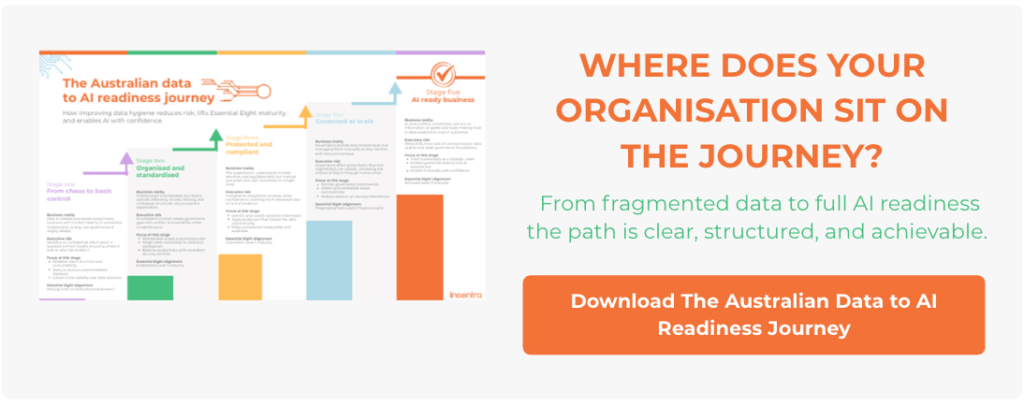
The Australian Data to AI Readiness Journey maps the complete five-stage progression in a single, structured reference from the business reality at each stage, to the executive risks of stalling, to the precise focus required to progress. It is designed for board and executive use.
AI will not reward ambition alone. It will reward preparation. The organisations that recognise this now will scale AI confidently, operate with clarity, and withstand regulatory scrutiny. Those that delay will find their governance gaps exposed not by auditors, but by their own AI tools.
The Next Step for Executive Teams
AI readiness is not a technology conversation. It is a governance clarity conversation.
If your organisation is investing in AI, scaling collaboration platforms, or progressing Essential Eight maturity, the most valuable discussion you can have right now is a structured assessment of your information foundations.
In a focused 30 minute executive session, we will:
- Clarify where your organisation sits on the Data to AI Readiness Journey
- Identify governance gaps that AI is likely to expose
- Highlight immediate structural risks across visibility, ownership, protection, lifecycle, and enforcement
- Outline the practical path to Stage 4 and Stage 5 maturity
This is not a sales presentation.
It is a strategic working discussion designed for board members, CIOs, CISOs, and executive leaders responsible for risk and growth.
AI will amplify whatever foundation already exists.
The question is whether that foundation is ready.
If you would value a direct, structured conversation about your organisation’s position and next steps, book an executive briefing here.
In 2026 and beyond, advantage will belong to the most disciplined. The conversation to determine that advantage should happen now.
References
1 Office of the Australian Information Commissioner, Notifiable Data Breaches Report 2024