

Many organisations begin their Microsoft Intune and Modern Device Management journey with a simple expectation: replacing legacy endpoint management platforms with a cloud-first approach should make endpoint management easier.
Yet the reality is often more complicated. Months after adopting Microsoft Intune, IT teams frequently find themselves managing environments that still feel complex, fragmented and operationally difficult to govern. Policies continue to proliferate, application delivery remains inconsistent, ownership responsibilities are unclear, and administrative effort remains stubbornly high despite significant investment in modern tooling.
This often leads to an important question. If endpoint management has been modernised, why does the environment still feel complex?
The answer may be that organisations are expecting Modern Device Management to solve a problem it was never designed to address. Understanding why endpoint complexity often survives Modern Device Management requires looking beyond the technology itself and examining the operating model that surrounds it.
The Problem Modern Device Management Was Designed to Solve
Much of the discussion around endpoint modernisation focuses on simplification. However, Modern Device Management was not primarily designed to eliminate organisational complexity. It was designed to solve a scale and distribution problem.
Traditional endpoint management models relied on assumptions that no longer consistently apply. Devices were expected to spend most of their time connected to corporate networks, management infrastructure was hosted on-premises, and users generally worked from predictable office locations.
The way organisations operate today is fundamentally different. Workforces are distributed, devices regularly operate outside corporate networks, and employees expect to work productively from almost anywhere. The challenge is no longer simply managing devices; it is managing them consistently and securely without dependence on infrastructure designed for a different era.
Platforms such as Microsoft Intune address this challenge by shifting endpoint management towards cloud-based, identity-driven control. For organisations supporting hybrid work and distributed device estates, this represents a significant evolution in how endpoint services are delivered.
However, solving the distribution problem should not be confused with solving the complexity problem. These are fundamentally different challenges, and success in one does not automatically deliver success in the other.
The Complexity Was Always There
One of the more interesting outcomes of endpoint modernisation programmes is that complexity rarely disappears. Instead, it becomes easier to see.
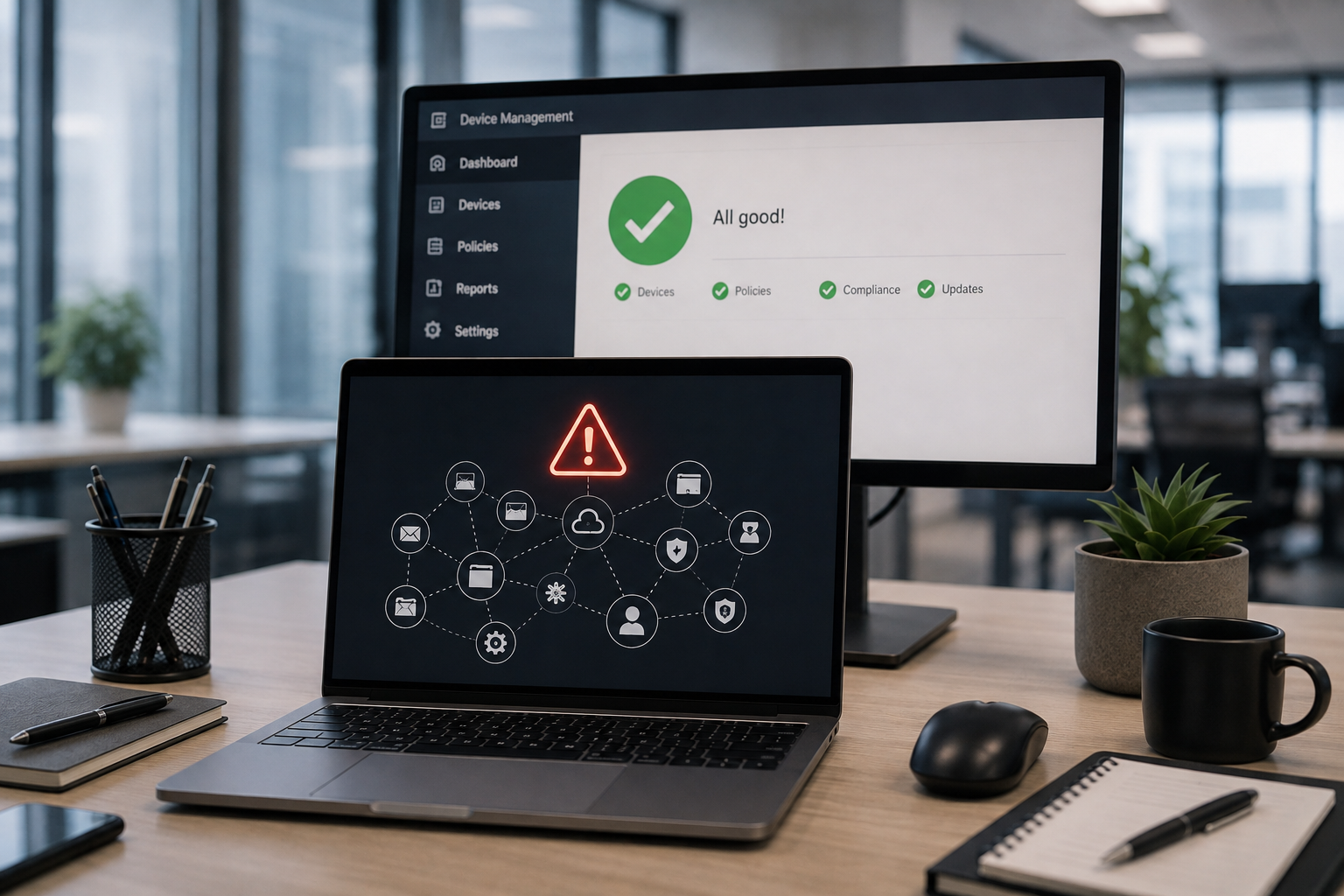
In many respects, Modern Device Management acts as an organisational mirror. It reflects existing operational complexity with greater clarity than traditional management models, making inconsistencies, ownership gaps and process inefficiencies increasingly difficult to ignore.
Legacy endpoint environments often contain years of accumulated decisions, exceptions and operational workarounds. These may include duplicated policies, fragmented ownership models, bespoke application packaging processes, inconsistent security controls and provisioning approaches that vary across different parts of the organisation.
A common example is device provisioning. Many organisations adopt modern provisioning models yet continue to maintain numerous deployment variations based on historical business requirements. What initially appears to be a technology challenge often turns out to be a combination of undocumented exceptions, inconsistent standards and competing stakeholder expectations.
Application management frequently reveals similar patterns. During modernisation programmes, organisations are often surprised by the number of application versions, packaging approaches and deployment methods that have accumulated over time. The platform does not create these inconsistencies; it simply makes them more visible.
As organisations modernise endpoint management, they often find themselves confronting questions that may have existed for years but never required an explicit answer:
- Why are multiple teams responsible for application delivery?
- Why do devices performing the same role require different configurations?
- Why does onboarding vary across business units?
- Why do policies exist that no longer align with current security requirements?
- Why are operational processes still built around assumptions that users primarily work inside a corporate office?
- Why do different areas of the organisation manage similar technologies in fundamentally different ways?
While modern management platforms expose these questions, they do not answer them. Addressing them requires deliberate decisions around governance, ownership, standardisation and operating model design.
This is why many organisations complete technically successful modernisation programmes yet still feel they are managing a complex environment. The technology has changed, but the underlying behaviours and operational structures often have not.
When Modernisation Becomes Migration
One of the most common assumptions in endpoint transformation programmes is that moving to a modern platform will automatically drive simplification.
In practice, complexity often follows organisations into the new environment.
Existing policies are frequently recreated without challenging whether they remain necessary. It is not uncommon to see organisations migrate hundreds of policy settings into a modern management platform, only to discover that many were originally created to address issues that no longer exist. Technical debt becomes policy debt, and the new platform inherits complexity from the old environment.
Similar patterns emerge in application management. Responsibility for application delivery may be spread across endpoint teams, infrastructure teams, security teams and individual business units, each operating with their own processes and priorities. Modern tooling does not create that complexity, but it quickly highlights duplicated effort, ownership gaps and inconsistent deployment practices.
Many endpoint transformation programmes fail to realise their expected benefits not because the technology falls short, but because the organisation continues operating as though nothing has changed. The platform evolves while surrounding processes, governance structures and ownership models remain largely intact.
The result is an environment that is modern in technology but traditional in operation.
At its core, this is rarely a technology problem. Organisations that continue to struggle after modernisation are not typically those that implemented Modern Device Management. More often, they are organisations that approached modernisation as a platform migration rather than an opportunity to rethink how endpoint services should be governed, supported and delivered.
Why This Matters
The consequences of unresolved complexity extend well beyond endpoint management teams. When complexity persists, onboarding takes longer than necessary, application delivery becomes less predictable, support effort increases, governance becomes more difficult and security controls become harder to manage consistently.
The challenge is not complexity itself but the organisational cost that complexity creates over time. Delayed onboarding, duplicated administrative effort, inconsistent security controls, fragmented user experiences and slower service delivery all have measurable impacts on productivity, operational efficiency and risk.
This is one of the reasons endpoint modernisation programmes struggle to achieve expected business outcomes. The technology changes, but the sources of operational friction often remain untouched.
What the Most Successful Organisations Do Differently
The organisations achieving the strongest outcomes from Microsoft Intune and Modern Device Management are not necessarily those with the most sophisticated technology. More often, they are the organisations that are willing to simplify.
They challenge historical exceptions, reduce unnecessary variation, standardise operating practices and establish clear ownership boundaries. Most importantly, they define the problem they are trying to solve before determining how technology should support it.
In our experience, the most successful organisations are rarely those with the largest number of automation workflows or the most complex configurations. They are typically those that demonstrate the greatest discipline around standardisation and are willing to make deliberate trade-offs between flexibility and operational simplicity.
Rather than asking how to migrate existing processes into a modern platform, these organisations ask whether those processes should exist in their current form at all.
The benefits are tangible:
- Faster onboarding and device provisioning
- Reduced operational effort
- Improved consistency across the endpoint estate
- Greater agility when deploying applications and policies
- Stronger governance and security outcomes
- A more predictable end-user experience
These outcomes rarely result from technology alone. They emerge when technology and operating model evolve together.
Modern Device Management Is an Opportunity, Not an Outcome
Endpoint complexity often survives Modern Device Management for a simple reason. Modern platforms address the challenges of managing distributed devices, while many sources of complexity originate from governance, ownership models and operational processes.
A successful implementation does not necessarily mean an organisation has modernised endpoint management. It means the organisation now has an opportunity to do so.
Modern Device Management solves a very specific problem: managing and securing endpoints at scale in a distributed world without dependence on traditional infrastructure. What it does not solve is organisational complexity.
The organisations that achieve the strongest outcomes understand this distinction. They recognise that endpoint modernisation is not primarily a technology project but an opportunity to simplify how endpoint services are governed, standardised and delivered.
Before asking whether an endpoint management platform has been successfully modernised, organisations should consider whether the operating model supporting it has evolved as well. Modern Device Management provides visibility into complexity that may have existed for years, but visibility alone does not create improvement.
Modern Device Management Reveals Complexity, It Doesn’t Remove It
The organisations that realise the greatest value from Microsoft Intune are rarely those that deploy technology the fastest. They are the organisations that use the visibility created through modern management as an opportunity to simplify, standardise and rethink how endpoint services operate.
Ultimately, successful endpoint modernisation is not defined by the platform that is implemented but by the complexity that is removed once that complexity becomes impossible to ignore.
Where to Begin
Successful Modern Device Management starts with understanding the complexity that exists today and identifying the outcomes the organisation is trying to achieve. Our team works with organisations to assess their current endpoint environment, understand existing management practices, governance models and operational challenges, and explore how capabilities including Microsoft Intune, cloud-based management, identity-driven security and modern provisioning approaches can support a more consistent, secure and scalable endpoint management experience.
If your organisation is reviewing its endpoint management strategy or looking to understand how Modern Device Management can simplify operations, we would welcome the opportunity to discuss the challenges you are looking to solve and explore the approaches that best align with your technology landscape, workforce requirements and business objectives.
Ready to simplify your endpoint management?
Whether you’re planning an Intune deployment or reviewing your existing environment, we can help you simplify endpoint management and achieve better business outcomes.
Contact us to discuss your endpoint management strategy.