

Half of your workforce is already using AI at work. The problem is, most of them are doing it without structure, without confidence, and without your knowledge.
According to Gallup’s Q2 2026 survey of more than 22,000 employed US adults, 52% of employees now use AI in their role – up from just 21% in Q2 2023. But that headline masks a more uncomfortable truth: only 15% do so daily, while the majority dip in occasionally and without real direction. Awareness has arrived. Active, confident adoption has not.
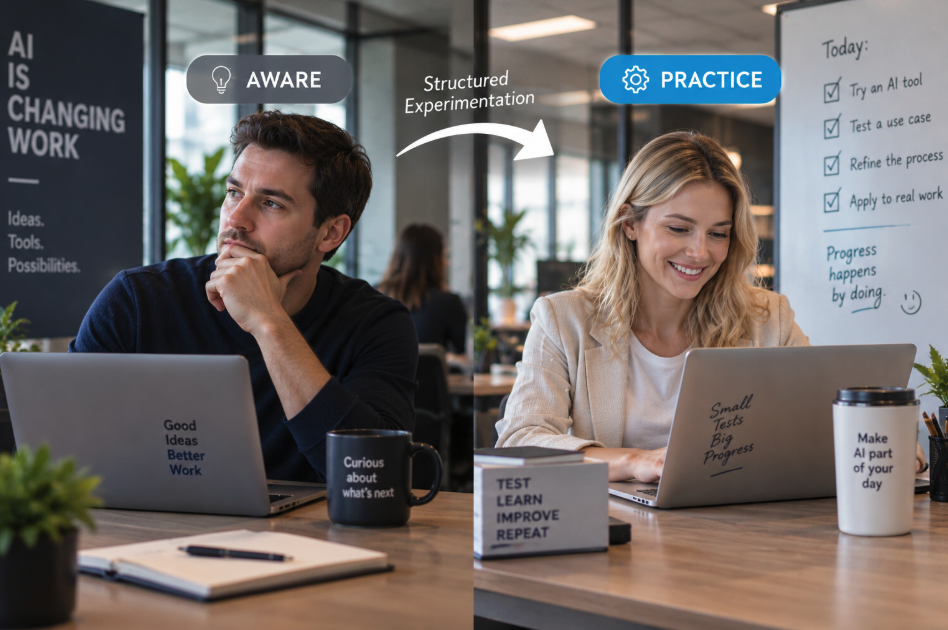
For IT leaders, CIOs, and CTOs, this is the gap that matters – and structured experimentation is how you close it.
The Awareness Trap
Many organisations have followed the same playbook: roll out a tool, run a webinar, share some use-case examples, and wait for adoption to follow. It rarely does.
Writer’s 2026 Enterprise AI Adoption survey found that 79% of organisations face challenges in adopting AI – a double-digit increase from 2025 – despite record investment levels. The issue is not access to tools. It is the absence of a safe, structured path from curiosity to competence.
Study.com’s 2026 State of AI Jobs and Skills Report reinforces this: 35% of employees have received no AI training of any kind, and of those who did receive training, only 18% say it prepared them to work independently. The majority are learning through trial and error, without structure or feedback loops.
Slingshot’s 2026 Digital Work Trends Report adds another layer: 34% of employees worry AI use will be perceived as cutting corners, and 27% fear being judged for it outright. Adoption anxiety is real, and no amount of vendor messaging resolves it.
What Actually Moves People From Watching to Doing
FleishmanHillard’s 2026 AI Readiness Gap research puts it plainly: what moves people from curiosity to confidence is relevance. When employees see how AI connects directly to their actual work – not a hypothetical slide-deck scenario – adoption shifts from mandate to momentum. Three elements make that happen.
1. Structured Experimentation Environments
A sandbox is not just a technical construct – it is a psychological one. When employees know they are in a contained environment where mistakes carry no real consequences, the experimentation cycle begins. CIO.com’s analysis of enterprise AI adoption captures it well: pre-configured guardrails give employees permission to try, fail, and try again – and that loop is exactly what turns first-time users into daily users.
Effective sandboxes are built around real tasks and real workflow contexts, not toy examples. The goal is to compress the time between first touch and genuine utility.
2. Clear Guardrails That Enable Rather Than Restrict
Guardrails are frequently framed as limitations. In practice, they are the very thing that makes confident exploration possible. Zylo’s 2026 SaaS Management Index found that 77% of IT leaders discovered AI-powered features or applications operating without their awareness. Employees are not defaulting to unmanaged tools out of recklessness – they are doing it because no sanctioned alternative exists.
SHRM’s 2026 research found that 46% of workers say current policies block them from testing new tools. Good guardrails solve this by creating structured permission – defining what data can be used with which tools, which outputs need human review, and which use cases are pre-approved for exploration – without requiring sign-off every time.
3. Low-Stakes Use Cases as the Entry Point
The fastest path to confident AI use runs through tasks where the stakes are manageable. Meeting summaries, first-draft communications, internal knowledge retrieval, email triage – these let employees compare AI output against their own judgment, build intuition, and course-correct without consequence.
This is not about limiting AI’s potential. It is about sequencing adoption intelligently. Structured pilots built around high-volume, low-risk workflows are consistently what separates successful AI deployments from those that stall. The majority of AI pilots do not scale to production – entry-point sequencing significantly improves those odds.
The Leadership Variable
None of this works without visible leadership engagement. Microsoft’s 2026 Work Trend Index found that when managers visibly use AI themselves – not just endorse it – employees report a 17-point lift in perceived AI value, a 22-point lift in critical thinking, and a 30-point lift in trust in agentic AI tools. The same report links psychological safety and active manager support to meaningfully higher rates of agentic AI adoption among employees.
For CIOs and CTOs, this is a direct lever. The experimentation culture you want to build starts with what you are seen doing yourself.
Building the Bridge
The organisations pulling ahead are not necessarily the ones with the most sophisticated tools. They are the ones that have made the path from curious to competent as short and safe as possible – investing in experimentation infrastructure, designing guardrails that open doors rather than close them, and choosing entry-point use cases that let employees build real confidence before the stakes get higher.
Passive awareness is not a foundation. Structured experimentation is.
Turn AI Awareness Into Confident Action
Your people are already experimenting with AI. The question is whether that experimentation is building capability or creating unmanaged risk.
AI Momentum by Insentra helps you turn scattered AI use into structured, confident adoption. We help you understand where your workforce is today, identify practical opportunities for AI, establish the right guardrails and give your people a safe environment to build confidence through real-world experimentation.
Don’t wait for AI adoption to happen by accident.
Give your people the structure, skills and confidence to use AI effectively every day.
Continue the Series: A Leader’s Guide to Building an AI-Ready Organisation
Building an AI-ready organisation takes more than deploying the right technology. It requires leaders to understand where their people are today, build the right skills and confidence, and create practical opportunities to put those skills into action.
Explore the other articles in our A Leader’s Guide to Building an AI-Ready Organisation series:
- You Bought the AI. Now What? Why People Readiness Is the Real ROI Problem — why the success of AI investment depends as much on people readiness as technology.
- A Practical Framework for Assessing AI Literacy Across Your Workforce — a practical approach to understanding current AI capability and identifying where development is needed.
- Building Organisation-Wide AI Literacy From the Ground Up — how to develop AI literacy across your organisation and create a stronger foundation for adoption.