

You have almost certainly heard the term “AI agent” more times this year than you can count. Vendors are building agents into helpdesk platforms, productivity suites, development tools and business applications.
The interest is not just marketing noise. Gartner’s 2026 Hype Cycle for Agentic AI reports that only 17 per cent of organisations have deployed AI agents so far, while more than 60 per cent expect to do so within the next two years. Gartner describes this as the most aggressive adoption curve among the emerging technologies measured in its survey.¹
Yet most explanations of AI agents are either too technical to support a practical business conversation or too vague to guide a decision.
Let us fix that.
An Agent Is Not Just a Chatbot
A conventional chatbot typically waits for a prompt and generates a response.
An AI agent is designed to pursue an objective and take actions on a user’s behalf. Depending on its design and permissions, it may break a task into steps, select tools, retrieve information, act within connected systems, examine the result and continue until it completes the task or requires human input.²
A simplified agent loop might look like this:
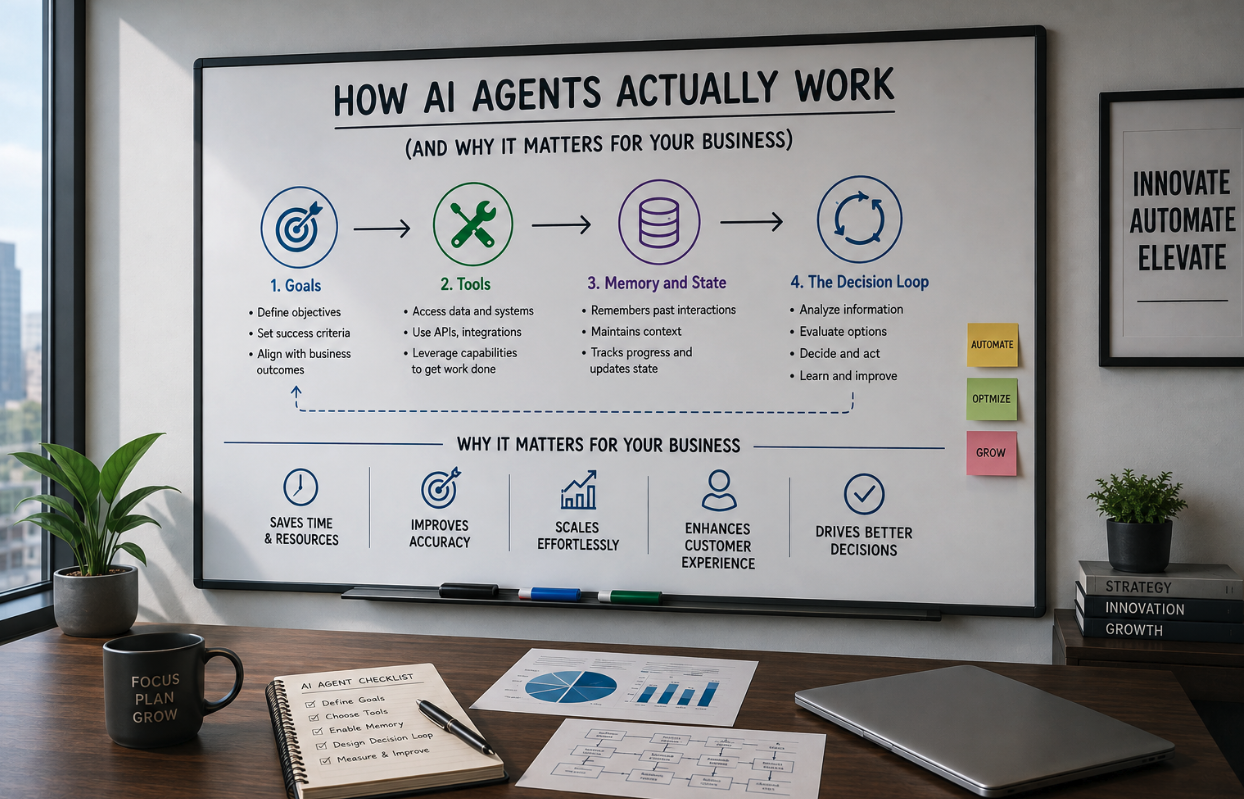
Goal → Gather context → Reason → Plan → Act → Observe → Update state → Continue
This is a useful conceptual model, rather than a universal technical specification. Different agents use different architectures. Some follow predefined workflows, while others can dynamically plan, select tools or hand work to another specialised agent.
The important distinction is that an agent is intended to move work forward, not simply discuss it.
The Four Building Blocks IT Leaders Should Understand
1. Goals
Every agent needs a defined objective.
A goal might be narrow, such as resetting a user’s approved VPN credentials, or broader, such as comparing three suppliers and producing a structured summary of their services and pricing.
The goal guides the agent’s decisions throughout the task. A well-designed agent should also have clear stopping conditions. It needs to know when the work is complete, when it has reached an approval boundary and when it should escalate to a person.
Without a clearly defined goal, an agent may produce technically plausible activity without delivering a useful business outcome.
2. Tools
Tools allow an agent to interact with systems and perform work.
A tool might provide access to:
- A calendar
- A database
- A web search service
- A service desk platform
- A customer relationship management system
- An approved script
- An email or messaging service
- An internal knowledge base
Tools are effectively the agent’s hands. The model can reason about a task, but tools allow it to retrieve current information, update records or complete authorised actions.
Microsoft provided a clear enterprise example in April 2026, when it made agentic capabilities in Word, Excel and PowerPoint generally available. Microsoft says Copilot can perform multi-step, app-native actions directly within documents, worksheets and presentations while keeping the user in control.³
Tool access is also where much of the risk resides. An agent that can read a knowledge base presents a different risk profile from one that can change permissions, issue refunds, delete records or send external communications.
Permissions should therefore be limited to the minimum access required for the task.
3. Memory and State
Agents need a way to preserve relevant information while work is underway.
Short-term state can include the original objective, information already retrieved, actions already taken and results received. It helps the agent maintain continuity across a multi-step task.
Longer-term memory may preserve selected information across sessions, such as user preferences, previous interactions or organisational procedures. Agent memory is generally intended to help systems recall useful context and support more relevant decisions.⁴
However, memory does not automatically make an agent smarter or more accurate. Its value depends on what is stored, how long it is retained, how it is secured and whether the information remains correct.
Poorly governed memory can preserve outdated information, expose sensitive data or cause an agent to apply the wrong context to a new task.
IT leaders should therefore consider:
- What the agent is allowed to remember
- Where that information is stored
- How long it is retained
- Who can access it
- How users can correct or remove it
- Whether the agent should use memory for a particular decision
4. The Decision Loop
The decision loop is where the agent evaluates what to do next.
At each stage, an agent may consider the goal, the information available, the actions already taken and the tools it is permitted to use. It then selects an action, observes the result and determines whether to continue, stop or seek human approval.
This ability to make runtime decisions is what makes agents useful for work that cannot be fully captured in a rigid script.
It is also what creates risk.
An agent may choose the wrong tool, misinterpret incomplete information, rely on an unreliable source or take an action that is technically permitted but inappropriate in context.
Governance must therefore be built into the operating loop. This can include:
- Defined permissions
- Approved data sources
- Spending or transaction limits
- Human approval gates
- Logging and traceability
- Output validation
- Escalation rules
- Continuous testing and evaluation
Gartner predicts that more than 40 per cent of agentic AI projects will be cancelled by the end of 2027 because of factors including escalating costs, unclear business value and inadequate risk controls.⁵
The lesson is not that agents should be avoided. It is that autonomy without boundaries is not a deployment strategy.
What AI Agents Look Like in Practice
Scheduling
An agent could be asked to organise a six-person project kickoff.
With the appropriate permissions, it might review calendar availability, account for time zones, identify suitable options, prepare an agenda, send invitations and monitor responses.
A well-governed version might still require human approval before sending invitations or booking external participants.
Research
A procurement team could ask an agent to identify potential cloud backup suppliers.
The agent might search approved sources, retrieve product information, structure a comparison and identify gaps that require human investigation.
The resulting analysis should still be reviewed, particularly where pricing, contractual terms, security claims or regulatory obligations are involved.
IT service management
Agentic service management platforms can support routine requests by retrieving knowledge articles, gathering diagnostic information, running approved workflows, updating tickets and notifying users.
Potential use cases include:
- Password reset workflows
- Standard access requests
- Software provisioning
- Basic VPN troubleshooting
- Ticket classification
- Knowledge retrieval
- Status updates
The strongest candidates are usually tasks that are repeatable, measurable and governed by clear policies.
Higher-risk actions should require stronger identity checks, stricter permissions and human approval.
Why Governance Must Match Autonomy
Not every agent requires the same governance model.
An agent that drafts an internal summary should not be governed in the same way as an agent that changes user access, handles personal information or initiates a financial transaction.
Gartner warned in May 2026 that applying the same governance model to every agent can itself create problems. It predicts that by 2027, 40 per cent of enterprises will demote or decommission autonomous agents because of governance failures.⁶
Governance should therefore reflect:
- The agent’s level of autonomy
- The sensitivity of the data involved
- The reversibility of its actions
- The potential impact of an error
- The level of human oversight required
- The evidence needed for audit and compliance
The more consequential the action, the stronger the controls should be.
The Practical Takeaway for IT Decision Makers
Agentic AI is moving rapidly into mainstream enterprise software.
Gartner forecasts that 40 per cent of enterprise applications will include task-specific AI agents by the end of 2026, up from less than 5 per cent in 2025.⁷
That does not mean every organisation should immediately automate every workflow.
The organisations most likely to succeed will start with a clearly scoped business outcome, choose tasks suited to agentic execution and establish boundaries before granting meaningful autonomy.
A practical starting point is to ask:
- Is the objective specific and measurable?
- Does the process have clear rules and escalation points?
- Which systems and data must the agent access?
- What is the impact if the agent is wrong?
- Which actions need human approval?
- Can every important action be logged and reviewed?
- How will accuracy, cost, risk and business value be measured?
The technology matters, but the operating model matters more.
Ready to Move From Understanding to Action?
Explore Insentra’s AI Momentum practice to see how we help organisations move from fragmented experimentation to governed, measurable AI adoption.
The organisations that gain the most from AI agents will not necessarily be those that deploy the greatest number.
They will be the ones that give agents the right goals, the right tools, the right boundaries and the right level of human oversight.
References
- Gartner, “2026 Hype Cycle for Agentic AI”, 2026.
- OpenAI, “Agents Cookbook” and “Building Agents”.
- Microsoft, “Copilot’s agentic capabilities in Word, Excel, and PowerPoint are generally available”, 22 April 2026.
- IBM, “What Is AI Agent Memory?”
- Gartner, “Over 40% of Agentic AI Projects Will Be Canceled by End 2027”, 25 June 2025.
- Gartner, “Applying Uniform Governance Across AI Agents Will Lead to Enterprise AI Agent Failure”, 26 May 2026.
- Gartner, “40% of Enterprise Apps Will Feature Task-Specific AI Agents by 2026”, 26 August 2025.