

Why Agentic AI Is a Category Shift, Not a Feature Update
Generative AI gave businesses a highly capable assistant. Agentic AI is beginning to give them a new way to organise and execute work.
That distinction can sound like marketing language. Once translated into practical capabilities, however, it becomes one of the most important strategic questions facing CIOs and CTOs.
What You Already Know About Generative AI
Most business leaders now have a working understanding of generative AI.
A person provides a prompt and the system produces a response. It might draft a report, summarise a document, analyse information or explain a complex subject. Platforms such as Microsoft 365 Copilot, ChatGPT and Google Gemini have made these interactions increasingly familiar.
That familiarity is valuable, but it has also created a misconception. The next wave of enterprise AI is not simply the same technology producing better answers.
Agentic AI changes what the system is expected and permitted to do.
A Fundamentally Different Operating Model
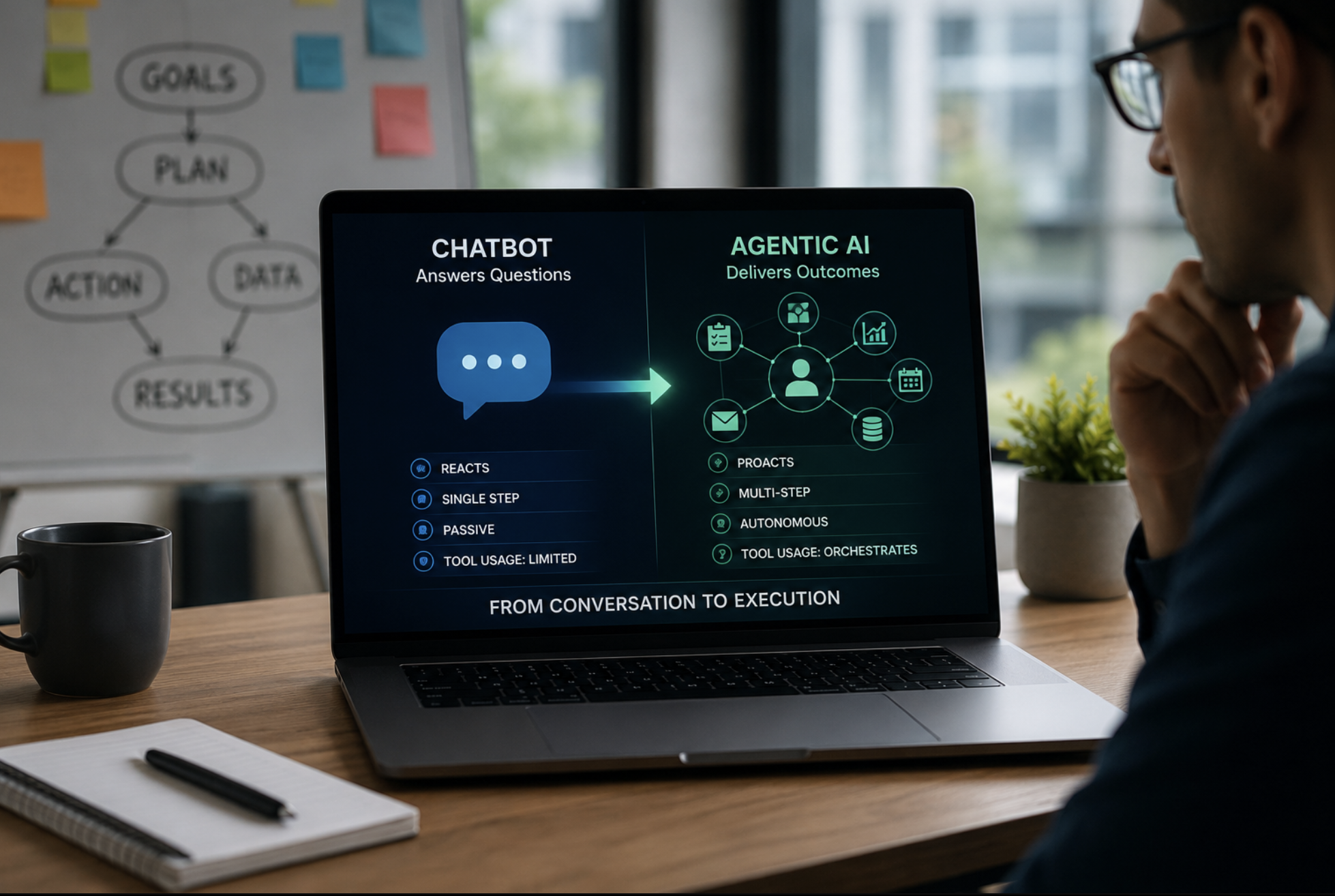
Generative AI primarily creates or transforms content in response to a request.
An agentic AI system is designed to pursue an objective within defined boundaries. Depending on its architecture, permissions and configuration, it may break an objective into tasks, select tools, retrieve information, interact with connected systems, evaluate results and adapt when conditions change.
The shift is from producing an output to participating in the completion of a workflow.
Consider employee onboarding.
A generative AI assistant could draft a welcome email or create an onboarding checklist. An agentic system given the goal of onboarding an employee could retrieve approved HR information, initiate software licence requests, schedule orientation meetings, send tailored communications and escalate exceptions for human review.
The process would still require connected systems, clear permissions, reliable data and appropriate governance. The AI would not independently acquire unlimited authority. It would operate within a deliberately designed scope.
Even with those limitations, the system would be participating in the execution of work rather than simply advising a person about what to do.
That is more than smarter autocomplete. It is a new operational capability.
Enterprise Adoption Is Accelerating
Gartner predicts that 40 per cent of enterprise applications will integrate task-specific AI agents by the end of 2026, up from less than 5 per cent in 2025.¹
Major technology providers are also moving their enterprise platforms in this direction.
Microsoft introduced Wave 3 of Microsoft 365 Copilot on 9 March 2026, describing it as a move beyond assistance towards embedded agentic capabilities. Copilot Cowork, which is designed for long-running, multi-step work across Microsoft 365, became generally available worldwide on 16 June 2026.
Microsoft is also developing a governance and management layer for these systems. Agent 365, which became generally available on 1 May 2026, extends identity, security, observability and data-governance capabilities to AI agents. Microsoft Copilot Studio also supports multi-agent orchestration and can connect with external agents using the open Agent2Agent protocol.
Microsoft calls its proposed organisational destination the Frontier Firm. It describes this model as human-led and agent-operated, with people setting strategy and retaining oversight while agents execute an increasing share of processes and workflows.
This remains a vendor-defined vision rather than a universally adopted operating model. Nevertheless, it illustrates the direction in which major enterprise platforms are developing.
The shift extends beyond Microsoft.
At Think 2026, IBM announced six key enhancements to watsonx Orchestrate. IBM positioned the platform as a way for enterprises to manage, govern and optimise agents created across different teams, tools and frameworks.
On 7 April 2026, EY announced a global rollout of enterprise-scale agentic AI within its Assurance practice. EY described the program as a fundamental shift towards AI-transformed audits, while emphasising that assurance professionals remain responsible for professional judgement and final conclusions.
These announcements do not mean that fully autonomous enterprises have arrived. Nor do they prove that every deployment will deliver measurable value.
They do show that agentic capabilities, along with the controls required to manage them, are moving rapidly into mainstream enterprise platforms.
Why IT Leaders Need a Different Approach
For CIOs and CTOs, agentic AI introduces challenges that conventional generative AI did not create at the same scale.
Governance and identity
An AI assistant may provide information to a user. An AI agent may authenticate with a system, call an application programming interface, modify a record, initiate a transaction or communicate with another person or agent.
Agents that can take these actions should be treated as governed non-human identities.
Their permissions should follow least-privilege principles. Their actions should be observable and auditable. Organisations also need clear ownership, lifecycle controls and procedures for restricting or suspending an agent when its behaviour, risk profile or business purpose changes.
Microsoft Agent 365 and Entra reflect this emerging requirement by extending access, identity and security controls to agents acting through their own identities or on behalf of authorised users.
The principle applies beyond any individual vendor. An agent should receive only the access required for its approved purpose, for only as long as that access is needed.
Autonomy with guardrails
Part of an agent’s potential value comes from its ability to complete approved steps without requiring human authorisation for every action.
However, autonomy should not be treated as an all-or-nothing decision.
BCG recommends a graduated model that progresses through shadow mode, supervised operation, guided autonomy and full autonomy. Each level should be earned through demonstrated performance and matched to the sensitivity and risk of the task.
In shadow mode, an agent may recommend actions without executing them. In supervised mode, it may act only after approval. Guided autonomy may allow it to act within defined thresholds, while full autonomy should be limited to use cases where performance, controls and reversibility have been proven.
A system that recommends an internal meeting time may require relatively light oversight. A system that changes customer records, approves expenditure or communicates externally should be subject to stronger controls.
The appropriate level of autonomy should depend on consequence, not novelty.
The pilot-to-production gap
Building an impressive demonstration is not the same as operating a dependable enterprise system.
Gartner predicts that more than 40 per cent of agentic AI projects will be cancelled by the end of 2027 because of escalating costs, unclear business value or inadequate risk controls.2
Agentic workflows may involve repeated model calls, retrieval processes, integrations, monitoring, exception handling and human escalation. Costs and operational complexity can therefore grow quickly when a pilot moves into production.
A demonstration might succeed under controlled conditions with carefully selected inputs. A production system must handle incomplete data, unavailable applications, contradictory instructions, permission failures, unexpected user behaviour and changing business rules.
Successful organisations will treat governance, evaluation, security and observability as elements of the underlying architecture rather than controls to be added after deployment.
They will also define what acceptable performance means before granting an agent greater authority.
Accountability remains human
An agent may execute an action, but the organisation remains responsible for the outcome.
Every agentic use case should therefore have a clearly identified business owner, an approved level of autonomy, measurable performance thresholds and a defined process for human intervention.
Ownership should not end when an agent is launched. Organisations need continuing reviews of access, performance, risk, cost and business relevance.
Without this accountability, an agent risks becoming an unmanaged automation layer whose actions are difficult to explain, challenge or reverse.
Human oversight must also be meaningful. A nominal approval step offers little protection when the reviewer lacks the information, authority or time required to identify a problem.
The Strategic Question Has Changed
The question for IT leaders is no longer simply whether their organisation should experiment with agentic AI.
The more useful questions are where agentic systems can create measurable value, what authority they should receive and what technical and governance foundations are required to operate them safely.
That requires organisations to:
- Select use cases with clear and measurable business outcomes
- Apply levels of autonomy according to risk and consequence
- Extend identity and access controls to non-human actors
- Monitor agent decisions, actions, costs and exceptions
- Establish clear business and technical ownership
- Maintain meaningful human oversight
- Design for failure, rollback and escalation
- Test agents against realistic and adverse conditions
- Review permissions and business purpose throughout the agent lifecycle
Agentic AI is not merely another feature added to an existing chatbot. It represents a structural change in how software can participate in business processes.
The organisations that benefit most will not necessarily be those that deploy the greatest number of agents. They will be those that connect autonomy to accountability, technology to measurable business value and speed to effective governance.
Turn Agentic AI Into Business Momentum
Agentic AI creates significant opportunity, but lasting value depends on choosing the right use cases, establishing effective governance and building a clear path from pilot to production.
Insentra helps IT leaders develop practical agentic AI strategies that align technology, security and business outcomes. Whether you are assessing where to begin, strengthening governance or scaling existing initiatives, we can help you move forward with greater confidence and control.
Explore AI Momentum to identify your next steps and start building an agentic AI roadmap designed for measurable business impact.
References