

There is a telling contradiction sitting at the heart of most enterprise AI programs right now. Organisations are spending more on AI tools than ever before, adoption is accelerating, and yet nearly two-thirds of organisations have not scaled AI beyond a handful of pilots, according to McKinsey’s 2026 State of AI report. The training isn’t working – and the reason is simpler than most leaders want to admit: the training is the same for everyone.
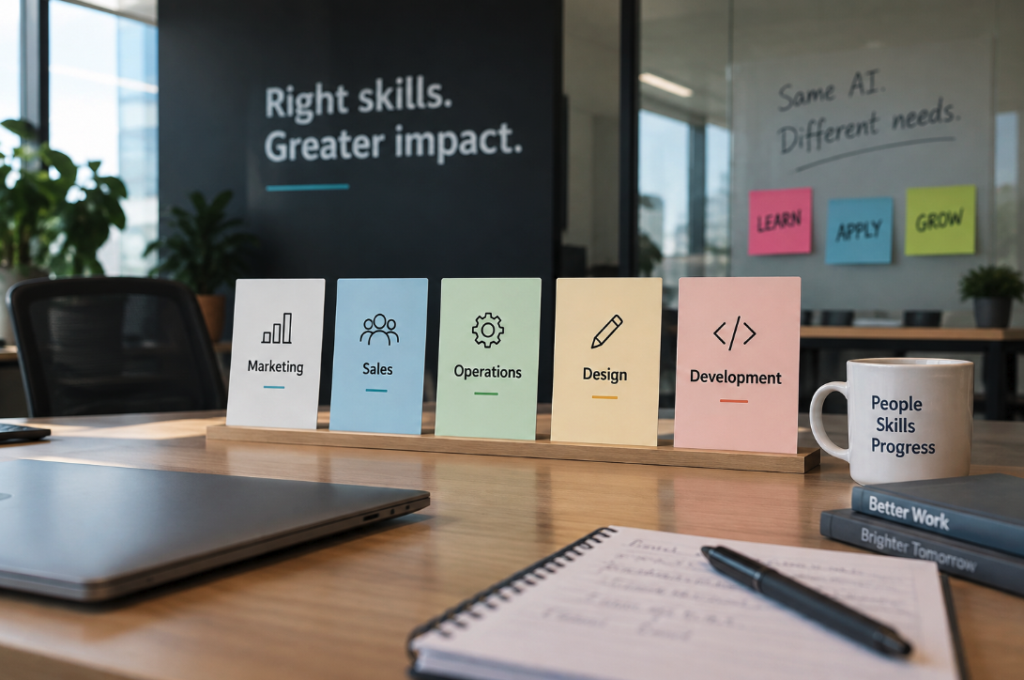
A blanket AI literacy program delivered to a service desk technician, a CFO, and a cloud architect is not a training strategy. It is a checkbox. The workflows are different, the pressures are different, the decisions are different – and the skills needed to use AI effectively are, accordingly, completely different.
This is the next challenge in becoming an AI-ready organisation: moving beyond broad awareness and building the role-specific capability that turns AI knowledge into everyday practice.
This article is part of our A Leader’s Guide to Building an AI-Ready Organisation series, exploring the practical steps leaders can take to turn AI investment into workforce capability and measurable business value.
The Data Makes the Case
The numbers paint a clear picture. Industry research consistently finds that while a large majority of employees will participate in AI training when it is offered, fewer than half can identify situations where AI would meaningfully improve their outcomes. That gap - between willingness and applied capability – is not a motivation problem. It is a relevance problem.
BCG’s AI at Work research puts a sharper edge on it. While leaders (88%) and managers (78%) use GenAI several times a week, only 51% of frontline workers do so regularly. BCG calls this the “silicon ceiling” – a structural gap in AI adoption driven not by resistance, but by the fact that generic training rarely connects to the specific work frontline employees actually do day to day.
Microsoft’s 2026 Work Trend Index adds another dimension. Among AI power users – what the report calls Frontier Professionals – 80% say they now produce work that would have been impossible a year ago. Among the broader AI-using population, that figure drops to 58%. The gap is not about access to tools. It is about depth of skill applied to specific, real-world contexts.
Three Audiences, Three Entirely Different Needs
The Knowledge Worker: Make It Immediately Useful
For frontline knowledge workers – the people in customer service, operations, finance, HR, and sales – AI training needs to answer one question within the first five minutes: how does this make my job easier today?
Abstract concepts about large language models or AI ethics frameworks are not the entry point here. What works is showing a customer service agent how to draft a response summary in thirty seconds, or demonstrating to an analyst how to query a data set through natural language rather than waiting on IT. The Skillsoft 2026 AI Skills Gap report found that fewer than one in four employees receive any AI training before new tools are introduced into their environment. When training does arrive, it is often too conceptual to stick.
Role-specific training for this cohort should be workflow-first: grounded in the tools they already use, the processes they already follow, and the time pressures they already face. It should be short, repeatable, and reinforced in the flow of work – not delivered as a one-off session that competes with their actual job.
The IT Professional: From User to Builder to Governor
IT professionals occupy a unique and often overlooked position in the AI skill equation. They are simultaneously expected to use AI tools in their own work, build and deploy AI-enabled services for the rest of the organisation, and govern the risks those services introduce.
That is three distinct capability sets – and most AI training programs address only one of them, if any.
Gartner has flagged that a significant proportion of the engineering workforce will need to upskill through 2027 as generative AI reshapes software development, infrastructure management, and operations. IDC’s research has similarly warned that a large majority of organisations worldwide will feel real pain from IT skills shortages by 2026, with AI skills in the highest demand. Yet the content those professionals need – understanding agent workflows, prompt engineering for technical tasks, AI security posture, governance frameworks, and responsible deployment – is rarely packaged in a way that maps to their actual day-to-day responsibilities.
For IT teams, training must go beyond basic literacy and into applied technical capability: how to evaluate AI output quality, how to integrate AI into existing pipelines, how to identify AI output failures or bias before they create operational or reputational exposure, and how to explain these concepts to non-technical stakeholders. The last skill is increasingly critical as IT leaders are asked to advise the C-suite.
Senior Leaders: Strategy, Judgment, and Governance
Executives do not need to know how to write a system prompt. They need to know how to make consequential decisions about AI – and to hold their organisations accountable for the ones being made on their behalf.
McKinsey’s 2026 research notes that 46% of leaders cite skill gaps as the single biggest barrier to AI ROI. Yet the training executives typically receive is either superficial (a half-day overview of AI concepts) or too technical to connect to strategic decision-making. What they actually need is fluency in AI governance: understanding where liability sits when an AI system makes an error, how to evaluate vendor claims, how to set policy on acceptable use, and how to read AI performance metrics with enough sophistication to ask the right questions.
Industry surveys of CIO priorities consistently find that AI upskilling now ranks among the top concerns for digital transformation leaders – and the programs gaining traction are those that link AI capability directly to business outcomes, risk frameworks, and competitive positioning.
For CTOs and CIOs specifically, the Microsoft 2026 Work Trend Index is instructive: only 13% of firms currently reward AI-driven workplace reinvention. That means the majority of organisations have not yet aligned their culture, incentives, and operating models to the AI strategies they claim to be pursuing. Senior leaders who are genuinely AI-fluent can see that gap – and close it.
Designing Role-Aware AI Programs That Actually Work
Building a role-differentiated AI capability program is not as complicated as it sounds, but it does require intentional design. Effective role-differentiated programs share four design principles:
Segment before you build. Map your workforce into distinct learning cohorts based on how AI intersects with their actual work – not their job titles. A senior analyst may need closer to IT-level technical depth than a junior manager.
Anchor every module to a workflow, not a concept. Training that starts with “here is what AI can do” fades. Training that starts with “here is the task you do every week, and here is how AI changes it” sticks.
Measure application, not attendance. The Skillsoft 2026 AI Skills Gap report also notes that only 18% of HR and L&D leaders continuously measure workforce AI readiness. Completion rates tell you nothing. What matters is whether behaviour changes in the work environment after training.
Make it continuous. AI tools are evolving fast enough that a training program built in January can be partially obsolete by June. Build recurring touchpoints – quarterly refreshes, role-specific updates as new capabilities release – rather than treating upskilling as a project with an end date.
The Strategic Imperative
AI capability is becoming a competitive differentiator at every level of an organisation – not just for the engineers who build with it, but for the workers who use it and the leaders who govern it. PwC’s 2026 Global AI Jobs Barometer shows that workers with advanced AI skills already earn 62% more than peers without them in equivalent roles, a premium that has continued to rise year-on-year. That premium reflects real productivity differences – and those differences compound as AI tools grow more powerful.
The organisations that will lead are not the ones that deployed AI fastest. They are the ones that built genuine, role-specific capability across their workforce – and structured learning around how people actually work, rather than how a generic curriculum assumes they do.
Ready to move beyond one-size-fits-all AI training? Insentra’s AI Momentum Framework is built to help organisations design and execute role-aware AI capability programs that connect to real business outcomes. Explore our thinking and approach at AI Momentum.
A Leader’s Guide to Building an AI-Ready Organisation
Buying AI is easy. Building an organisation that knows how to use it well is the harder part.
Becoming AI-ready isn’t a single training initiative or technology deployment. It’s a journey from understanding whether your people are ready, to identifying capability gaps, building foundational literacy and ultimately turning that knowledge into new ways of working.
That’s the focus of our A Leader’s Guide to Building an AI-Ready Organisation series. Each article tackles a different stage of that journey:
1. Start with readiness
You Bought the AI. Now What? Why People Readiness Is the Real ROI Problem explores why deploying the technology isn’t enough — and why workforce readiness can determine whether your AI investment creates value or becomes another underused tool.
2. Understand where you stand
A Practical Framework for Assessing AI Literacy Across Your Workforce provides a practical approach to identifying the AI knowledge, confidence and capability that already exists across your organisation — and where the gaps are.
3. Build the foundations
Building Organisation-Wide AI Literacy From the Ground Up looks at how to establish a shared foundation of AI understanding so employees can engage with the technology confidently, responsibly and effectively.
4. Turn knowledge into action
How Structured AI Experimentation Turns Passive Awareness Into Daily Practice takes the next step: moving from knowing about AI to developing role-relevant skills people can apply to the work they do every day.
The progression matters: readiness → assessment → literacy → application.
Because AI readiness isn’t achieved when people complete the training. It’s achieved when people have the confidence, capability and opportunity to start working differently.
Turn AI Readiness Into AI Momentum
Ready to move beyond one-size-fits-all AI training?
Insentra’s AI Momentum Framework is built to help organisations design and execute role-aware AI capability programs that connect learning to real work and real business outcomes.